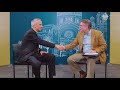
I enjoy doing school visits when I can celebrate Mass with the school community and visit classrooms besides.
That They May All
Be One
Archbishop John C. Nienstedt
In a recent question-and-answer session, a young student asked me why we kneel at Mass. I responded by saying that we, as human beings, are both body and spirit and that these two elements have a very direct influence on one another.
Archbishop Nienstedt's Calendar
» Friday, Aug. 20 to Friday, Sept. 3: Spanish course offered by the International Institute for Culture in Puebla, Mexico.
» Tuesday, Sept. 7: 8:30 a.m., St. Paul, Archbishop’s Residence: Scheduling meeting with staff.
9:30 a.m., St. Paul, Chancery: Archbishop’s Council meeting.
noon, St. Paul, Chancery: Presbyteral Council meeting.
» Wednesday, Sept. 8: 5 p.m., St. Paul, St. Mary’s Chapel at St. Paul Seminary: Opening Mass for academic year with faculty’s Profession of Faith and Oath of Fidelity and banquet.
» Thursday, Sept. 9: 9 a.m., St. Paul, Chancery: Report on schools.
11 a.m., St. Paul, Chancery: Meeting in preparation for Presbyteral Council meeting.
6 p.m., St. Paul, Archbishop’s Residence: Dinner for 2010 new investees to the Equestrian Order of the Holy Sepulchre of Jerusalem.
Obviously, whenever we pray we use our whole body, because we know that
is the best way to engage our hearts fully. When we stand or kneel, bow
or genuflect, we are expressing in action what we mean to say from our
heart. Kneeling expresses adoration, humility and willing service.
Deeper meaning
The more I have thought about it, however, the more I realized there was much more to add to this answer.
Kneeling is not a common gesture in our society. People stand up for
what they believe and they stand in the presence of dignitaries. We leap
to our feet with joy at a touchdown of the Vikings or the presence of a
loved one.
But kneeling is a much more meaningful and intimate gesture. A man takes
to his knee when proposing to his future wife. We kneel in the presence
of overwhelming mystery. We kneel to adore, and to ask for mercy, to
offer humble reverence to our God.
The rubric for kneeling at Mass is found in the General Instruction of the Roman Missal (GIRM 2003), 43:
“The faithful should stand from the beginning of the Entrance chant, or
while the priest approaches the altar, until the end of the Collect; for
the Alleluia chant before the Gospel; while the Gospel itself is
proclaimed; during the Profession of Faith and the Prayer of the
Faithful; from the invitation, “Orate, fratres” (Pray, brethren), before
the prayer over the offerings until the end of Mass, except at the
places indicated below.
“. . . In the dioceses of the United States of America, they should
kneel beginning after the singing or recitation of the Sanctus until
after the Amen of the Eucharistic Prayer, except when prevented on
occasion by reasons of health, lack of space, the large number of people
present, or some other good reason. Those who do not kneel ought to
make a profound bow when the priest genuflects after the consecration.
The faithful kneel after the Agnus Dei unless the Diocesan Bishop
determines otherwise.”
It should be noted that the universal GIRM states the faithful should
kneel during the consecration from the first epiclesis to the memorial
acclamation, but the U.S. bishops have requested and received permission
for Catholics in the U.S. to kneel from the Sanctus until the Amen.
They have done this because they believe that this gesture has important
pastoral significance for U.S. Catholics in their reverence for the
Eucharist.
Some context and history
As can be seen from the GIRM, the fundamental posture of the liturgy is
standing. Standing is the natural gesture of respect toward authority —
even today we stand when someone enters the room.
This is why the assembly stands when the celebrant enters and exits the
church. Indeed, we know that standing is the normal posture for prayer
we received from our Jewish ancestors and was common for early Christian
prayer as well.
Standing is considered in the tradition to be the sign of the
resurrection, as St. Basil the Great says in his treatise on the Holy
Spirit: “We pray standing, on the first day of the week, but we do not
all know the reason. On the day of the resurrection (or ‘standing
again’; Greek ‘anastasis’) we remind ourselves of the grace given to us
by standing at prayer, not only because we rose with Christ, and are
bound to ‘seek those things which are above,’ but because the day seems
to us to be in some sense an image of the age which we expect …”
(Chapter 27).
It is this connection to the Resurrection which can still be found in
rubrics which say that during the Easter season certain prayers, like
litanies, are said standing and not kneeling.
Kneeling, however, is also an ancient posture of prayer. It seems that
kneeling, both in the Christian and the Jewish tradition, was the
posture used in especially intense periods of prayer and repentance.
Thus, Solomon dedicating the very first Temple to the Lord, prayed
“kneeling down in the presence of all the multitude of Israel, and
lifting up his hands towards Heaven” (2 Chronicles 6:13; cf. 1 Kings
8:54).
St. Stephen is described before his martyrdom in intense prayer:
“falling on his knees, he cried with a loud voice” (Acts 7:59). St.
Peter prayed kneeling when he asked God to raise Tabitha from the dead
(Acts 9:40).
We see that the Lord himself prayed kneeling at the most intense moment
of his agony in the Garden: “kneeling down, he prayed” (Luke 22:41).
The Book of Revelation describes the faithful kneeling even in heaven,
when the 24 elders “fall down before him who is seated on the throne and
worship him who lives forever and ever; they cast their crowns before
the throne.”
At the most intense moments of prayer and adoration it is a natural gesture to fall to one’s knees.
The liturgy originally saw kneeling mainly as a penitential prayer,
which is why the Council of Nicaea (A.D. 325) forbade penitents to kneel
on Sundays and during the Easter season.
However, the meaning of this gesture developed in the tradition of our
church so that little by little the gesture lost its exclusively
penitential connotation. During the Middle Ages, in order to emphasize
the reverence due to the real presence of Jesus in the Blessed
Sacrament, kneeling took the additional meaning of profound respect and
adoration that is prevalent today.
Lost reverence
We live in a society that has in many ways has lost reverence for things
which are holy and sacred. We approach God in a way that is casual,
almost as if he is on the same level as us. This lack of reverence can
really reflect a lack of humility. It is a lack of recognition of who
God is and who I am, and how I need to come before God with humility and
reverence.
Humility is not a prized virtue in our society which often focuses on
putting one’s self at the center of life, rather than God. Christianity,
on the other hand, has always prized humility as the way to heaven, in
imitation of Christ who humbled himself to come among us as human in
order to restore us to communion with God.
As St. Paul made clear in Philippians 2:5-8: “Have this mind among
yourselves, which is yours in Christ Jesus, who, though he was in the
form of God, did not count equality with God a thing to be grasped, but
emptied himself, taking the form of a servant, being born in the
likeness of men. And being found in human form he humbled himself and
became obedient unto death, even death on a cross.”
It is for this reason, Christ’s humility, that he is exalted above
heaven and earth by the Father. And as St. Paul says, “that at the name
of Jesus every knee should bow, in heaven and on earth and under the
earth” (Philippians 2:10).
Here we find two important pastoral reasons why the U.S. bishops have
required that all Catholics kneel during the Eucharistic Prayer from the
Sanctus until the conclusion of the great Amen.
First is the desire to emphasize the real presence of Christ in the
Eucharist. We stand when we pray, except at those moments which are most
sacred to us, those moments when Christ’s presence is most near. Then,
in reverential adoration, we kneel before the Lord of the universe, even
as the priest genuflects after the words of consecration.
Second, we live in a society in which people almost never kneel, all the
more reason to keep this gesture of humility in our worship before God.
When we kneel we remind ourselves that we are not God and we are not in
charge; rather, we are only creatures before our Lord who loves us so
much that he comes to us as food to sustain our spiritual lives.
Yes, there is a lot behind the question of why we kneel at Mass. It is good to know why we do so.