Where do you fit in? Community.
Catholic organizations seek to protect state's poor this session Print E-mail
By Maria Wiering   
Thursday, 04 February 2010
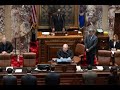
5a_legislature2010.jpgEnsuring health care, reducing poverty and supporting nonpublic education will be among top priorities for two Catholic public policy groups when the state Legislature convenes Feb. 4.

The focus of this legislative session will be a bonding bill, which will invest funds into Minnesota’s infrastructure, such as roads and bridges. Gov. Tim Pawlenty released his proposal for the bill Jan. 15,  calling for $685 million in general obligation bonding. House Speaker Margaret Anderson Kelliher said she expects her chamber to pass a $1 billion bonding bill.

For the state, a bonding bill is like taking out a home mortgage to pay for  a home — it is an investment in things the state needs and expects to pay for over time, like public roads, buildings and bridges, said Patrick Ness, public policy manager for the Office for Social Justice, the public policy arm of the Twin Cities’ Catholic Charities.

He was speaking at a Jan. 19 OSJ-hosted 2010 legislative briefing.

As it prepares a bonding bill, the Legislature also faces a projected $1.2 billion budget deficit for the current fiscal year of 2010-2011, and a projected $5.4 billion deficit for 2012-2013. The Minnesota Constitution requires the Legislature to balance the budget, but it would not be required to do so for the current fiscal year until it ends on June 30, 2011.

“We’re already preparing for . . . significant cuts to Minnesota safety net programs,” said Alexandra Fitzsimmons, MCC policy director. “It’s nice when we get to be more proactive, and have that kind of approach, but this is going to be defensive posturing and trying to protect . . . different programs that will likely be affected by any proposed cuts.”

MCC is the Minnesota bishops’ public policy arm.

Be heard on the hill


Save the date for three upcoming events in which Catholics plan to help shape Minnesota public policy.

» Feb. 25
ACCW (Archdiocesan Council for Catholic Women) Legislative Day.
Best Western Kelly Inn, St. Paul. 9 a.m. to 2 p.m. Cost $10. To register call (651) 291-4545.

» Feb. 27
“If not we, then who? If not now, then when. A Minnesota Without Poverty Event.”

6 to 9 p.m. at Olson Campus Center, Luther Seminary. RSVP to This e-mail address is being protected from spam bots, you need JavaScript enabled to view it

» March 25
Joint Religious Legislative Coalition (JRLC) Day on the Hill.
Visit www.jrlc.org for more information or to register for the event.
Health care for the poor

Health care for the poorest Minnesotans will be a chief issue in the first weeks of the session.

OSJ will be among the leaders at a Feb. 4 rally to support funding for General Assistance Medical Care, or GAMC. In order to qualify for GAMC, one’s assets must be less than $1,000. Ninety-two percent of GAMC recipients have incomes less than 25 percent of the federal poverty guidelines.

Pawlenty cut the program’s budget in his June 2009 unallotment of the state’s budget for the current fiscal year. Funding for GAMC is expected to expire March 1.

Although the session has yet to begin, lawmakers are crafting proposals to address health care for the estimated 33,000 individuals enrolled each month in GAMC.

MCC hopes to support a bill that would provide health care for this demographic that would not also provide for state-funded abortions, Fitzsimmons said.

The conference is also working on legislation that would support low-income women and families. It is seeking to repeal the Minnesota Family Investment Program’s family cap, which denies cash assistance to children born 10 months or more after a family has enrolled in the program, and promoting the Minnesota Pregnant Women and Parent Support Act, which would offer additional health care and  supportive services for pregnant women.

Focusing on programs to help lift Minnesotans out of poverty, OSJ plans to work toward passing a bonding bill with housing and job opportunities for low-income Minnesotans and protecting the interests of low-income Minnesotans as the budget is balanced, Ness said.

The Jan. 19 OSJ legislative briefing featured HIRE Minnesota, a new organization formed to ensure that public infrastructure and renewable energy investments also work to lift people out of poverty by providing jobs to low-income minority workers. OSJ is a HIRE organization member.

Additionally, OSJ and MCC plan to support the MCC-crafted Ladder Out of Poverty Task Force bill and related legislation, which comes from suggestions put forth from the Legislative Commission to End Poverty in Minnesota by 2020.

These suggestions include a reform of payday lending operations and measures to increase financial literacy. MCC and OSJ also plan to work toward criminal justice records reform for offenders who committed felonies at ages 16 and 17. Under the current system, it is difficult for juveniles to move beyond their felony and pursue education and employment, Fitzsimmons said.

Eye on education

MCC also plans to advocate for legislation that supports nonpublic schools, said Peter Noll, MCC education director. He expects to work with public schools to use more efficiently public funding that supports special education in nonpublic schools, which include Catholic schools.

MCC also plans to keep the Equity and Opportunity in Education Tax Credit Bill in the minds of legislators, Noll said. The bill proposes tax credit incentives for corporations and individuals who contribute to education foundations that make it possible for low-income students to attend the school of their choice, including Catholic schools.

“Many of these [bills] get introduced one session. You hope they get passed that session, but you’re cultivating the soil, too. You’re trying to educate lawmakers along the way, so when the climate is right, . . . some of this legislation will get passed,” Noll said.

In November, all the lawmakers and the governor will be up for re-election. MCC and OSJ expect this to play into the types of legislation introduced — and not introduced — this session as legislators unofficially campaign for their — or the governor’s — seat. Pawlenty announced  in June 2009 that he will not run for a third term.


Comments (0)


Show/hide comments

Write comment


busy